
Non-toxic sleep accessories are products made from certified safe materials, free from harmful synthetic chemicals, designed to reduce your exposure to toxins during the hours you are most vulnerable. No official regulatory definition of “non-toxic” exists in the US or Canada for sleep products, which means trusted third-party certifications like GOTS, GOLS, and MADE SAFE carry the full weight of verification. Choosing safe sleep gear is not about chasing a perfect label. It is about knowing which certifications matter, which materials to avoid, and where to focus your effort for the greatest health benefit.
How to choose non-toxic sleep accessories: start with certifications
The most important step in any safe sleep products selection process is understanding what certifications actually verify. GOTS (Global Organic Textile Standard) covers both organic fibre content and safer processing methods. GOLS (Global Organic Latex Standard) applies to natural latex. MADE SAFE certifies overall product safety across all ingredients. OEKO-TEX STANDARD 100 tests for harmful chemicals like formaldehyde and heavy metals, but it does not guarantee organic fibres. Each standard answers a different question, so matching the right certification to the right product category is the foundation of this guide.
CertiPUR-US is widely recognised but frequently misunderstood. CertiPUR-US covers foam content only, not fire barriers or adhesives. A mattress can carry this mark and still contain chemical flame retardants in its barrier layer. Knowing this distinction saves you from a common and costly mistake.
What makes a mattress the highest-risk item in your bedroom?
The mattress is the single highest-impact accessory for chemical exposure reduction. You spend roughly a third of your life in direct skin contact with it, and a quality mattress lasts a decade or more. That combination of duration and proximity makes material choices here more consequential than anywhere else in the bedroom.
Polyurethane foam, chemical flame retardants, and synthetic adhesives are the three materials to avoid in any mattress claiming to be non-toxic. Polyurethane foam off-gasses volatile organic compounds (VOCs) for months after manufacture. Chemical flame retardants, used to meet flammability regulations, include compounds linked to hormone disruption. Synthetic adhesives bind layers together and contribute a secondary VOC source that is rarely discussed.
For a toxic-free mattress, look for these features:
- GOLS certification on the latex core, not just the cover
- GOTS certification on all textile components, including the ticking
- MADE SAFE certification for full ingredient transparency
- No chemical flame retardants, replaced instead by a natural wool barrier
- Verified component-level certification, because mattress covers can hold GOTS status while underlying foam layers carry no equivalent standard
Bed frames deserve attention too. Solid wood frames with CARB Phase 2 compliance emit significantly fewer VOCs than composite wood or particleboard alternatives. CARB Phase 2 is a California Air Resources Board standard that limits formaldehyde emissions from wood products. It is the most practical benchmark available for furniture safety in the UK and North America alike.
Pro Tip: Ask the retailer for a component-by-component certification breakdown before purchasing any mattress. A single GOTS label on the cover does not mean the entire mattress meets organic standards.
What are the best non-toxic pillow materials?
The best non-toxic pillows use natural fills that require minimal chemical processing. The most trusted options are:
- Organic cotton, soft and breathable, with GOTS certification confirming both fibre and processing
- Natural latex, resilient and hypoallergenic, verified by GOLS
- Wool, naturally flame-resistant and moisture-wicking
- Kapok, a plant-based fibre with a light, down-like feel
- Buckwheat hulls, firm and adjustable, with no synthetic content
Synthetic foam pillows and chemically treated fibres present the same off-gassing risks as foam mattresses, scaled down but still present given nightly face-level contact. OEKO-TEX STANDARD 100 certification on pillow covers confirms the absence of harmful chemicals, but GOTS is the stronger standard if you want assurance about the entire production chain.
Natural fills also perform well for people with allergies. Wool resists dust mites naturally. Latex is inherently antimicrobial. Neither requires chemical treatments to achieve these properties, which is the point.
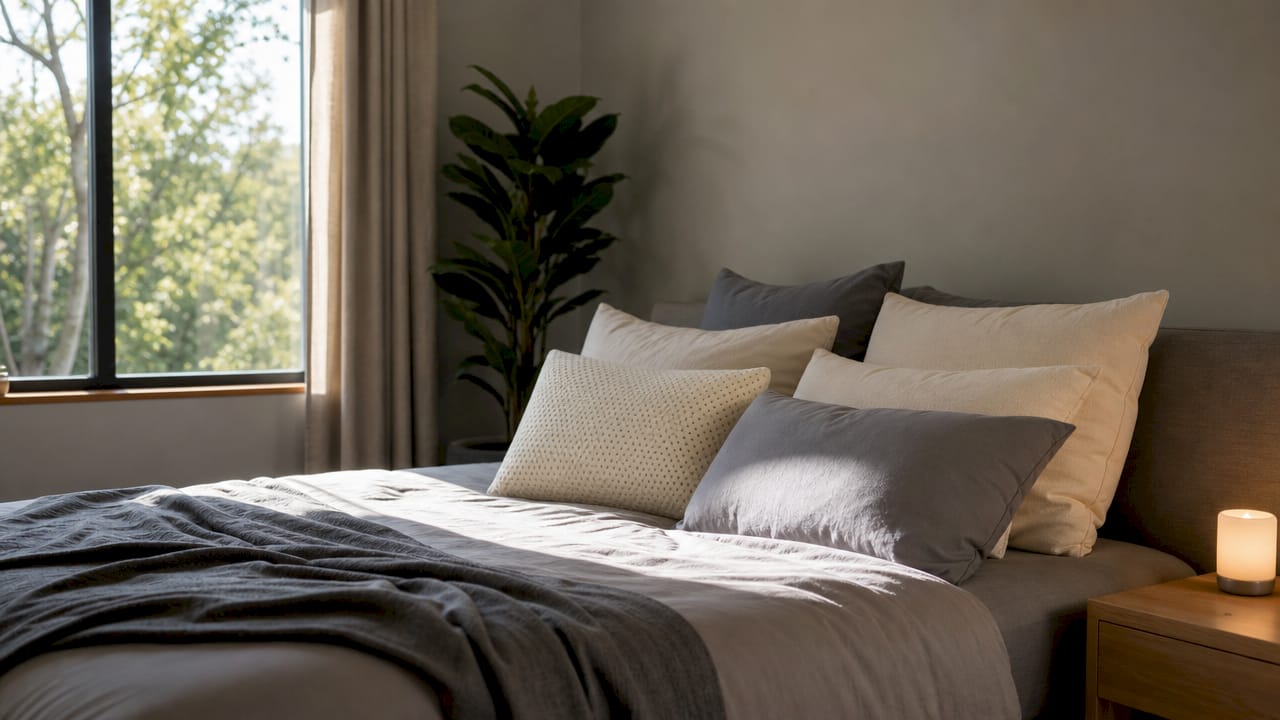
Pro Tip: Check whether the pillow’s outer shell and inner fill each carry separate certifications. A GOTS-certified shell stuffed with uncertified synthetic fill is not a non-toxic pillow.
How do non-toxic bedding options compare?
Selecting non-toxic bedding options means understanding both the fibre and the finish. The table below compares the most common eco-friendly sleep accessories in the bedding category.
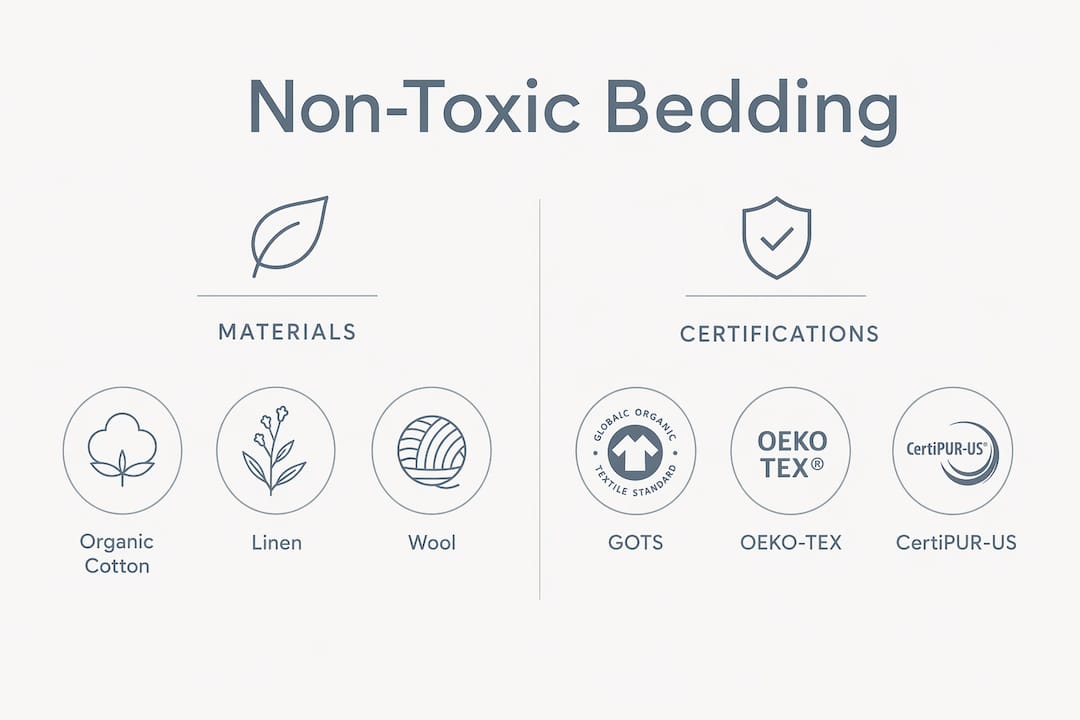
| Material | Certification to seek | Breathability | Key consideration |
|---|---|---|---|
| Organic cotton | GOTS | High | Most widely available; verify dye processes |
| Linen | GOTS or OEKO-TEX | Very high | Naturally low-input crop; softens with washing |
| Bamboo | OEKO-TEX STANDARD 100 | High | Processing is chemical-intensive; certification is non-negotiable |
| TENCEL (Lyocell) | OEKO-TEX or FSC | High | Closed-loop production; low environmental impact |
OEKO-TEX STANDARD 100 and GOTS answer different questions. OEKO-TEX confirms the finished textile is free from harmful residues. GOTS confirms the fibre was grown organically and processed without restricted substances. For bedding, GOTS is the stronger standard. OEKO-TEX is an acceptable baseline when GOTS-certified options are unavailable.
Mattress protectors require separate attention. PU-laminate protectors carry lower off-gassing risk than PVC or PFAS-treated fabrics. PFAS (per- and polyfluoroalkyl substances) are persistent chemicals used in waterproofing finishes and are best avoided entirely. Look for OEKO-TEX or MADE SAFE certification on any waterproof protector you buy.
Weave type affects comfort as much as fibre choice. Percale weave is crisp and cool, suited to warm sleepers. Sateen weave is smoother and slightly warmer. Neither is inherently safer than the other, but tighter weaves trap more heat, which affects sleep quality independently of chemical content.
How do you create a fully non-toxic sleep environment?
The bedroom environment extends well beyond the bed itself. Furniture, paint, and air quality all contribute to your total chemical exposure during sleep.
Bedroom furniture is a secondary but significant VOC source. Choosing solid wood over composite materials cuts VOC exposure substantially. When solid wood is not an option, look for CARB Phase 2 compliance on any pressed wood or MDF components. Upholstered furniture adds another layer of risk through foam padding and fabric treatments, so prioritise hard-surface alternatives in the bedroom where possible.
Paint is frequently overlooked. Standard interior paints release VOCs for weeks after application. Low-VOC and zero-VOC paints, verified by independent standards such as GREENGUARD Gold, reduce this source significantly. If you are redecorating, allow maximum ventilation time before sleeping in the room.
Key steps for a lower-toxicity bedroom:
- Choose low-VOC or zero-VOC paint with GREENGUARD Gold verification
- Select solid wood furniture or CARB Phase 2 compliant alternatives
- Avoid upholstered bed frames with foam padding and synthetic fabric treatments
- Use natural fibre rugs certified to GOTS or OEKO-TEX rather than synthetic carpeting
Opening bedroom windows regularly is the most effective and zero-cost way to reduce VOC concentrations indoors. Ventilation dilutes chemical build-up from furniture, mattresses, and textiles more effectively than most air filtration products. When outdoor air quality is poor, HEPA and activated carbon air purifiers provide a practical alternative. HEPA filters capture particulates; activated carbon adsorbs VOCs. Both together address different parts of the indoor air quality problem.
Pro Tip: Air your bedroom for at least 20 minutes each morning before making the bed. This single habit reduces accumulated VOC concentrations from overnight off-gassing at no cost.
What are the safe sleep rules for infants?
Infant sleep safety follows different rules from adult sleep accessory selection. For babies, suffocation risk outweighs toxicity concerns as the primary hazard.
The American Academy of Pediatrics (AAP) and The Lullaby Trust both recommend that infants sleep on a firm, flat surface in their own separate sleep space, with no pillows, blankets, bumpers, or soft-sided pods present. These guidelines exist because suffocation risk from soft items in the sleep environment is the leading preventable cause of sleep-related infant death.
For non-toxic nursery items, the priority order is: first, meet the firmness and flatness requirements; second, select a GOTS or GOLS certified mattress for the cot or bassinet. Avoid any cot mattress with chemical flame retardants. A natural wool layer provides compliant flame resistance without synthetic chemicals. Do not add a pillow, rolled blanket, or positioner regardless of how it is marketed. The safest infant sleep space is the simplest one.
Key takeaways
Selecting safe sleep products requires matching the right certification to each product category, starting with the mattress and working outward to bedding, furniture, and ventilation.
| Point | Details |
|---|---|
| Certifications carry the definition | No regulatory definition of “non-toxic” exists; rely on GOTS, GOLS, and MADE SAFE for verified safety. |
| Mattress is the highest priority | Polyurethane foam, flame retardants, and synthetic adhesives are the main risks; verify each component separately. |
| OEKO-TEX is not organic assurance | OEKO-TEX STANDARD 100 confirms chemical safety only; GOTS is required for organic fibre and processing guarantees. |
| Ventilation costs nothing | Opening windows daily reduces VOC concentrations more effectively than most filtration products. |
| Infant safety rules differ | Firm, flat, and bare surfaces take priority over toxicity concerns for babies under 12 months. |
Why I think most people overcomplicate this
Certification fatigue is real. I have spoken with people who spent months researching every label before buying a single sheet set, then gave up and bought whatever was on sale. That outcome is worse than a practical, prioritised approach.
Prioritising mattress and pillow certifications first reduces complexity and delivers the greatest health return. The mattress and pillow are where your skin and airways spend the most time. Get those right with GOLS, GOTS, or MADE SAFE verification, and you have addressed the majority of your chemical exposure risk. Bedding is important but secondary. Furniture is tertiary.
Ventilation is the insight most guides bury or skip entirely. I would argue it belongs at the top of every list. A GOTS-certified mattress in a sealed, poorly ventilated room still accumulates VOCs from paint, furniture, and textiles. Open the window. It is the most underrated sleep health habit available.
Do not chase perfect organic status across every accessory. Use trusted certifications as a baseline for the items that matter most, pair them with daily ventilation, and you will have a genuinely healthier sleep environment without spending years in a research spiral.
— Hadi
Somnastudioshop’s sleep accessories for a healthier bedroom
Somnastudioshop builds products that complement a well-considered sleep environment. Once your mattress, bedding, and ventilation are sorted, the next layer is managing light and sound, two factors that directly affect sleep quality regardless of what your bed is made from.
The SomnaSilk pure natural silk sleep mask blocks light without synthetic materials against your skin. The SomnaAura smart Bluetooth sleep mask combines light blocking with built-in sound, addressing two common sleep disruptors in one product. For portable white noise support, the SomnaSound machine creates a consistent audio environment that supports deeper rest. All Somnastudioshop products are designed with sleep hygiene in mind, making them a natural fit alongside the non-toxic bedroom principles covered here.
FAQ
What does non-toxic mean for sleep products?
“Non-toxic” has no official regulatory definition for sleep products in the UK, US, or Canada. Verified third-party certifications such as GOTS, GOLS, and MADE SAFE are the only reliable indicators of chemical safety.
Is OEKO-TEX the same as organic certification?
OEKO-TEX STANDARD 100 confirms a textile is free from harmful chemical residues but does not verify organic fibre content or farming practices. GOTS certification covers both, making it the stronger standard for organic assurance.
Which sleep accessory should I prioritise first?
The mattress is the highest-priority item because of its decade-long lifespan and continuous skin contact. Verify GOLS or MADE SAFE certification on each component, not just the cover.
Are infant sleep accessories different from adult ones?
Yes. For infants under 12 months, AAP and The Lullaby Trust guidelines require a firm, flat sleep surface with no pillows, bumpers, or soft accessories. Suffocation prevention takes priority over toxicity concerns at this age.
Does ventilation really reduce chemical exposure?
Opening bedroom windows daily is the most effective zero-cost method for reducing indoor VOC concentrations from furniture, mattresses, and textiles. When outdoor air quality is poor, a HEPA and activated carbon air purifier provides a practical alternative.