
Ambient noise aids sleep by raising the baseline sound level in your environment, which stops sudden sounds from jolting you awake. This process, known formally as auditory masking, is the primary mechanism behind the benefits of ambient noise for people who struggle to get consistent, deep rest. Research from 2025 and 2026 confirms that sounds such as white noise and pink noise improve sleep quality across different age groups and living conditions. Understanding how this works gives you a real advantage when choosing the right approach for your nights.
Why ambient noise aids sleep: auditory masking explained
Auditory masking is the process by which a steady background sound reduces the brain’s ability to detect sudden changes in the acoustic environment. Your brain does not fully switch off during sleep. The auditory system stays partially alert, scanning for sounds that signal danger, and a car door slamming or a neighbour’s television can trigger a startle response that pulls you out of deep sleep without you even realising it.
Ambient noise raises the baseline sound level in your room so that sudden sounds create a smaller contrast. Smaller contrast means fewer awakenings. Think of it like turning up the volume on a conversation in a noisy café. The background chatter does not disappear, but it blends into the room rather than cutting through it.
The most common disruptive sounds that auditory masking handles well include:
- Traffic noise and car horns from urban streets
- Voices or footsteps from shared walls or corridors
- Household appliances cycling on and off during the night
- A partner snoring or shifting position
Pro Tip: Place your ambient noise device between you and the primary noise source, such as a window or a shared wall, to get the most effective masking coverage.
What are the differences between white, pink, and brown noise?
Not all ambient noise is the same, and the type you choose affects how well it works for you.
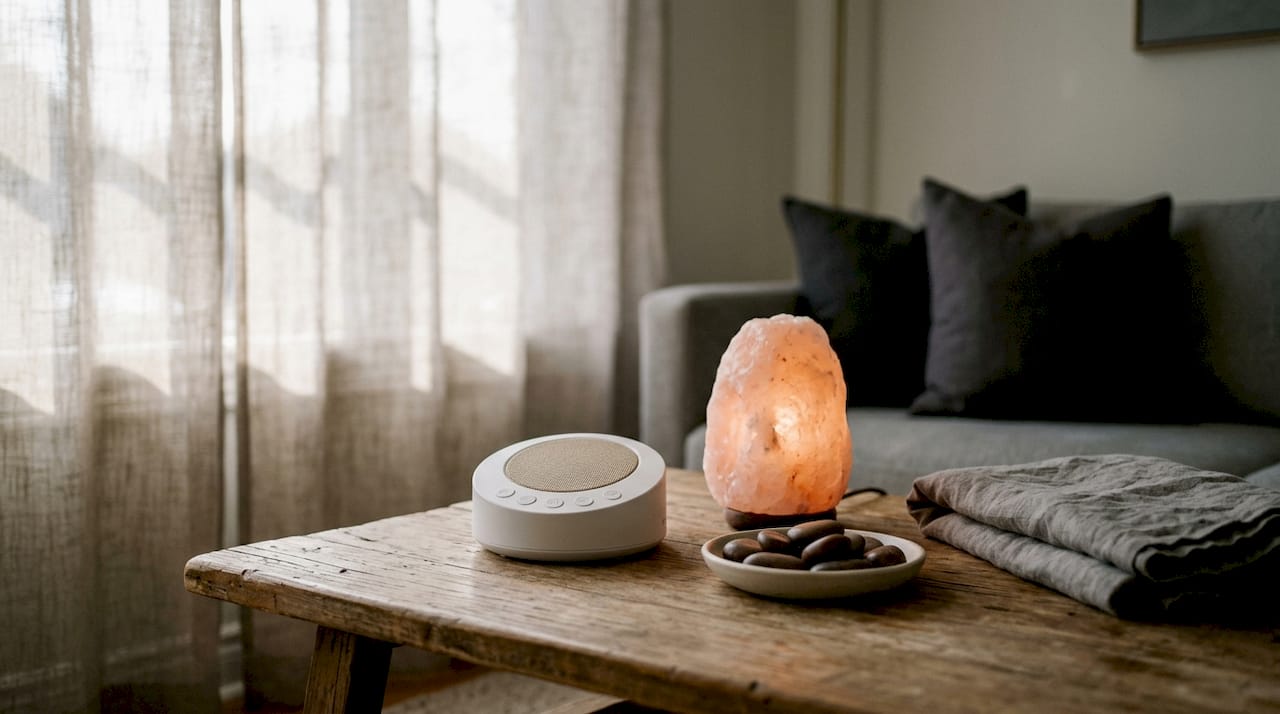
White noise contains equal energy across all audible frequencies. It sounds like television static or a fan running at full speed. Because it covers the entire frequency spectrum evenly, it is highly effective at masking a wide range of environmental sounds. White noise is the most widely studied type and the one most commonly used in clinical settings.
Pink noise has more energy in the lower frequencies, which makes it sound softer and more natural than white noise. Rainfall, rustling leaves, and gentle wind are real-world examples of pink noise. Pink noise is perceived as more relaxing than white noise by most people, and research suggests it may support deeper, more restorative sleep stages.
Brown noise goes even deeper, with the heaviest emphasis on bass frequencies. It resembles the sound of a strong river current or distant thunder. People who find white noise too harsh often prefer brown noise for its warmer, more enveloping quality.
| Noise type | Frequency profile | Perceived sound | Best suited for |
|---|---|---|---|
| White noise | Equal across all frequencies | Fan, static | Broad masking in noisy environments |
| Pink noise | More power in low frequencies | Rain, rustling leaves | Deeper sleep, relaxation |
| Brown noise | Heaviest in bass frequencies | River, distant thunder | People sensitive to high-pitched sounds |
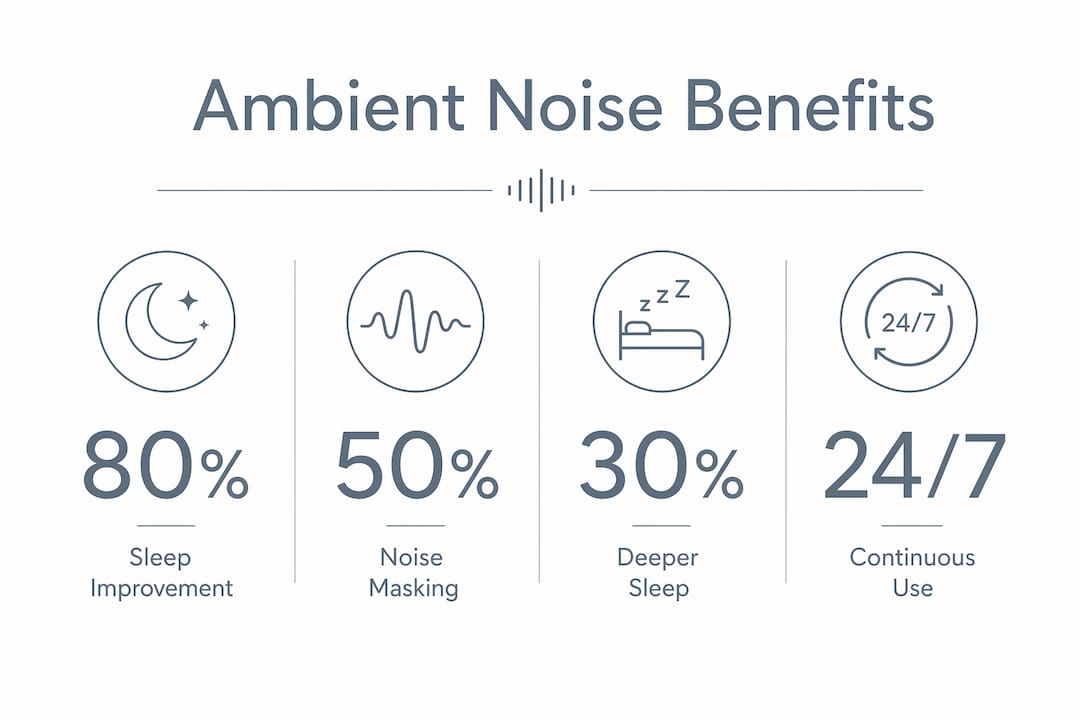
The choice between them is personal, but the science gives pink noise a slight edge for sleep depth. Research published in 2026 found that playing pink noise at around 60 dB helps people fall asleep faster and supports deeper sleep stages. That volume is roughly equivalent to a refrigerator humming in the next room.
What does the science say about ambient sound for better sleep?
The evidence base for sleeping with background noise has grown considerably in recent years, and the findings are consistent enough to take seriously.
A 2025 meta-analysis drawing on 12 randomised controlled trials with 1,301 participants found that white noise significantly improves sleep quality and extends total sleep time in both infants and adults. That is a large, well-controlled dataset. The effect was not marginal. Participants fell asleep faster and woke less frequently during the night.
Pink noise research adds another layer. Studies show that pink noise bursts during sleep can increase sleep spindle density, which is the brain’s natural mechanism for blocking out external stimuli during deep sleep. Higher spindle density means the brain is better at protecting its own rest. There is also emerging evidence that this effect may reduce the perception of chronic pain during the night, which is relevant for anyone whose sleep is disrupted by physical discomfort.
“Consistent background sound can become a conditioned cue signalling bedtime, helping the brain transition into sleep. When you use the same sound every night, your brain begins to associate it with the act of falling asleep, making the transition faster and more reliable over time.”
This conditioning effect is one of the most underappreciated benefits of ambient noise. It is not just about masking sounds in the moment. With consistent use, the sound itself becomes a sleep trigger, similar to the way a specific pillow or a darkened room signals to your brain that it is time to rest.
One important nuance: ambient sound is most beneficial in noisy environments. If you already sleep in a very quiet room, the gains are smaller. People in urban flats, shared houses, or near busy roads see the strongest results.
How to use ambient noise effectively at night
Getting the most from ambient noise requires more than simply pressing play on a sound file. A few practical decisions make a significant difference.
-
Set the right volume. The ideal range is 50–60 dB, which is loud enough to mask environmental sounds but quiet enough to avoid overstimulating your auditory system or risking hearing damage over time. A useful reference point is the sound of a refrigerator at close range.
-
Run sound continuously throughout the night. Using a timer is less effective than running sound all night. When ambient noise stops mid-sleep, the sudden silence can itself trigger an arousal response, waking you up. Continuous sound keeps the auditory environment stable from the moment you close your eyes until morning.
-
Position your device thoughtfully. Place it at a distance of at least 60 centimetres from your head. Closer placement increases the risk of hearing fatigue. Positioning it between you and the noise source, such as a window facing a street, maximises its masking effect.
-
Be consistent. Use the same sound every night. Consistency is what builds the conditioned sleep cue. Switching between different sounds or using ambient noise only occasionally reduces the psychological benefit over time.
-
Match the sound to your environment. Urban sleepers dealing with traffic and voices benefit most from white noise because of its broad masking range. People in quieter settings who simply want a more relaxing auditory backdrop often find pink noise more pleasant and effective.
Pro Tip: If you share a bedroom, try a sound mask device that delivers audio directly to your ears. This lets you control your personal sound environment without disturbing your partner.
Potential pitfalls to avoid include setting the volume too high in the belief that louder is better, relying on ambient noise as a substitute for good sleep hygiene rather than a complement to it, and expecting results after just one or two nights. The conditioning effect takes time to build.
Key takeaways
Ambient noise aids sleep primarily through auditory masking, which reduces the contrast between background sound and sudden noises, preventing the startle responses that fragment rest.
| Point | Details |
|---|---|
| Auditory masking is the core mechanism | Raising baseline sound reduces sudden contrasts that trigger awakenings during the night. |
| Pink noise edges ahead for depth | Research shows pink noise at around 60 dB supports faster sleep onset and deeper sleep stages. |
| Conditioning builds over time | Using the same sound nightly trains the brain to associate it with sleep, speeding up the transition. |
| Volume matters for safety | Keep ambient noise between 50–60 dB to mask effectively without risking hearing damage. |
| Context determines benefit | Ambient noise works best in noisy environments; quiet rooms see smaller but still real gains. |
What I have learned from years of watching people get this wrong
People tend to treat ambient noise as a last resort rather than a deliberate sleep tool. They download a rain sound, play it at full volume for three nights, decide it does not work, and move on. That is not a fair test of the method.
The conditioning effect is real, but it takes weeks, not nights. The brain needs repeated exposure to the same sound in the same context before it starts treating that sound as a reliable sleep signal. Patience is not optional here.
The other mistake I see constantly is volume. Louder does not mean better masked. Playing ambient noise at conversation volume or higher creates its own form of auditory stimulation. The goal is a steady, unobtrusive hum that sits beneath your awareness, not a sound you can clearly hear and identify.
I also think people underestimate how much their environment matters. Someone sleeping in a quiet countryside cottage will get far less from white noise than someone in a city flat above a pub. Knowing your own noise environment helps you set realistic expectations and choose the right type of sound. Experiment with white, pink, and brown noise across a few weeks each. Track how you feel in the morning. The right sound for you is the one that consistently produces better mornings, and that answer is different for everyone.
— Hadi
How Somnastudioshop products support your ambient noise routine
Somnastudioshop builds products specifically for people who take their sleep seriously. The SomnaAura Pro is a contour sound mask that delivers white noise directly to your ears, blocking light and environmental sound simultaneously. For a portable option, the SomnaSound white noise machine runs continuously through the night at a consistent, safe volume. If you want to go further, the SomnaPulse microcurrent device pairs well with ambient noise strategies by addressing physical tension and stress that ambient sound alone cannot resolve. Each product is designed to complement the sleep hygiene practices covered in this article.
FAQ
Does ambient noise actually improve sleep quality?
Yes. A 2025 meta-analysis of 12 randomised controlled trials with 1,301 participants found that white noise significantly improves sleep quality and extends total sleep time in adults and infants.
What volume should I use for ambient noise at night?
Keep ambient noise between 50–60 dB, roughly the level of a refrigerator hum. This is loud enough to mask disruptive sounds without overstimulating your auditory system or risking hearing damage.
Is pink noise better than white noise for sleep?
Pink noise is often perceived as more natural and relaxing, and research shows it can support deeper sleep stages and faster sleep onset. White noise covers a broader frequency range, making it more effective for masking varied environmental sounds.
Should I use a timer or run ambient noise all night?
Run it all night. Stopping ambient noise mid-sleep can trigger an arousal response when the sound cuts out suddenly. Continuous sound keeps the auditory environment stable and supports uninterrupted rest.
How long does it take for ambient noise to work as a sleep cue?
The conditioning effect builds over several weeks of consistent use. Using the same sound every night gradually trains the brain to associate that sound with sleep, making the transition faster and more reliable over time.