
A whole-body approach to sleep wellness is defined as the practice of addressing sleep through interconnected biological, environmental, behavioural, and nutritional factors rather than treating insomnia as a single isolated symptom. Functional medicine frames this as systemic treatment: find the root cause, then build the conditions for sleep to occur naturally. The evidence supports this framing. Consistent wake times and morning light produce measurable sleep improvements within 14–28 days when foundational habits stabilise. That timeline matters because it tells you change is possible without medication, provided you address the right levers in the right order.
What is a holistic approach to sleep wellness?
The industry term for this practice is integrative sleep medicine, though most people encounter it through functional medicine clinics and wellness practitioners. The core claim is straightforward: sleep success depends on creating biological conditions, not forcing sleep. That distinction separates this approach from conventional advice, which typically focuses on symptom management through sedatives or single-habit fixes.
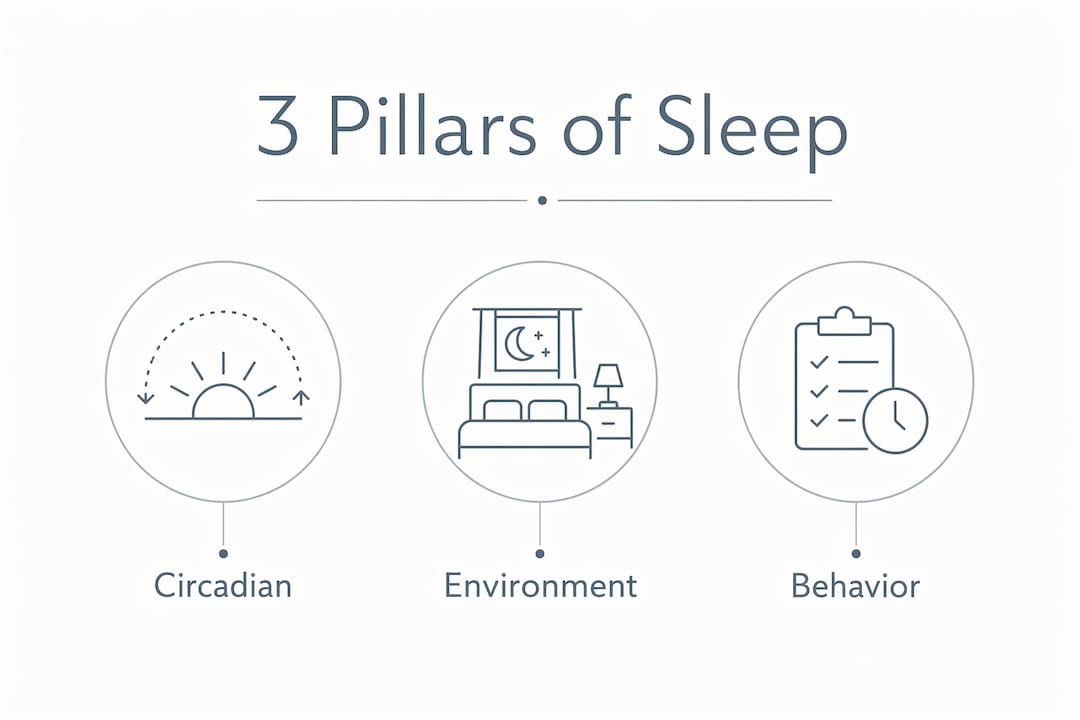
Three pillars define integrative sleep medicine. First, circadian biology: your body runs on a 24-hour internal clock that governs cortisol, melatonin, body temperature, and digestion. Second, environmental biology: the sensory conditions of your bedroom directly affect your arousal threshold and hormone timing. Third, metabolic health: blood sugar, thyroid function, and cortisol dysregulation all disrupt sleep architecture in ways that no amount of lavender spray will fix.

Understanding these three pillars changes how you prioritise. Most people start with bedtime rituals. The evidence says start with your morning instead.
How do you anchor your circadian rhythm with light and timing?
Morning light is the primary trigger for melatonin timing. Natural light exposure within 30–60 minutes of waking triggers the cortisol awakening response and sets the clock for melatonin release roughly 14–16 hours later. This is more impactful than any bedtime ritual you could adopt. The mechanism runs through the suprachiasmatic nucleus, a cluster of neurons in the hypothalamus that acts as your master biological clock.
The single most effective habit is a consistent wake time, seven days a week. Sleeping in at weekends shifts your circadian phase in the same way that flying west does. Your body experiences it as mild jet lag, and Monday morning feels correspondingly brutal. Fix your wake time first, then let sleep onset adjust naturally over two to four weeks.
A practical morning sequence looks like this:
- Wake at the same time every day, including weekends.
- Get outside or sit by a bright window within 30 minutes of waking.
- Delay caffeine for 90 minutes after waking to allow adenosine to clear naturally.
- Keep overhead lights bright in the morning and dim them progressively after 8:00 PM.
- Avoid bright screens for at least 60 minutes before your target sleep time.
Pro Tip: If you cannot get outside in the morning, a 10,000-lux light therapy lamp used for 20–30 minutes at your desk produces a comparable circadian signal.
The evening side of this equation is equally important. Blue light exposure 60–90 minutes before bedtime delays melatonin production and can push sleep onset back by over 90 minutes. Switching to warm-toned lighting and using blue-light-filtering settings on devices from early evening reduces this disruption significantly.
How does your bedroom environment affect sleep quality?
Your bedroom environment directly affects your arousal threshold and melatonin timing. Light, noise, and clutter each raise sympathetic nervous system activity, making it harder for your body to shift into the parasympathetic state required for sleep onset. Sensory optimisation is not aesthetic preference. It is biological necessity.
The key environmental factors to address are:
- Temperature: The optimal bedroom temperature is 18–20°C. This range supports the core body temperature drop that triggers sleep onset. A room that is too warm suppresses deep sleep stages.
- Light: Complete darkness is the target. Blackout curtains or a well-fitted sleep mask block the ambient light that suppresses melatonin even through closed eyelids.
- Noise: Consistent ambient sound, such as white noise or pink noise, masks disruptive spikes in sound that cause micro-arousals without you fully waking.
- Scent: Lavender and chamomile have modest evidence for reducing pre-sleep anxiety, though they work best as part of a consistent wind-down cue rather than as standalone remedies.
- Clutter: Visual disorder maintains cognitive activation. A tidy bedroom signals safety and rest to the brain’s threat-detection systems.
| Environmental factor | Target condition | Why it matters |
|---|---|---|
| Temperature | 18–20°C | Triggers core body temperature drop for sleep onset |
| Light | Complete darkness | Prevents melatonin suppression through closed eyelids |
| Noise | Consistent ambient sound | Masks disruptive spikes that cause micro-arousals |
| Clutter | Minimal visual disorder | Reduces cognitive activation and perceived threat |
Pro Tip: Run a fan or a portable white noise machine rather than silence. Silence is rarely silent, and a consistent sound floor makes your sleep far less vulnerable to intermittent noise.
Learning more about why ambient noise aids sleep can help you choose the right acoustic solution for your bedroom.
What behavioural habits reinforce healthy sleep?
Foundational behaviours must be solid before other techniques produce results. This is the part most people skip. They reach for supplements or gadgets before they have addressed caffeine timing, screen use, or their pre-bed routine.
A structured wind-down period of 30–60 minutes is the single most underused sleep tool. Consistent wind-down rituals signal the nervous system to shift from sympathetic to parasympathetic mode. Reading physical books, gentle stretching, journalling, or a warm bath all qualify. The activity matters less than the consistency of the cue.
Build your behavioural routine in this order:
- Set a caffeine cut-off at 1:00 PM. Caffeine has a half-life of roughly five to six hours in most adults, meaning an afternoon coffee still affects sleep architecture at midnight.
- Avoid alcohol within three hours of bedtime. Alcohol sedates initially but fragments sleep in the second half of the night as it metabolises.
- Begin your wind-down routine at the same time each evening, 30–60 minutes before your target sleep time.
- Remove digital devices from the bedroom. Keeping a phone in bed trains the brain to associate the bed with wakefulness, weakening the sleep cue.
- Reserve the bed for sleep only. Watching television or working in bed dismantles the stimulus control that makes lying down feel naturally sleep-inducing.
- If you cannot fall asleep within 20 minutes, get up and do a quiet, dim-light activity until you feel sleepy. Getting up after 20 minutes prevents negative conditioning between the bed and wakefulness.
Exercise supports sleep quality, but timing matters. Vigorous exercise within two hours of bedtime raises core body temperature and cortisol, which delays sleep onset. Morning or early afternoon exercise produces the greatest benefit for sleep depth.
What nutritional support actually helps sleep?
Targeted supplementation works when it sits on top of solid lifestyle habits. Used alone, supplements produce modest results. Used alongside consistent wake times, a dark cool bedroom, and a structured wind-down routine, they can meaningfully improve sleep depth and reduce night waking.
Magnesium glycinate at 300–400 mg, glycine at 3 g, and L-theanine at 200 mg are the three most evidence-supported options in functional medicine nutritional protocols. Magnesium glycinate supports GABA activity and muscle relaxation. Glycine lowers core body temperature and improves slow-wave sleep. L-theanine reduces pre-sleep anxiety without sedation.
| Supplement | Typical dose | Primary mechanism |
|---|---|---|
| Magnesium glycinate | 300–400 mg | Supports GABA activity and muscle relaxation |
| Glycine | 3 g | Lowers core body temperature, improves slow-wave sleep |
| L-theanine | 200 mg | Reduces anxiety without sedation |
The deeper issue is metabolic. Blood sugar instability and nocturnal hypoglycaemia cause night waking through cortisol release. If you consistently wake between 2:00 AM and 4:00 AM, blood sugar is a more likely culprit than stress. A small protein-and-fat snack before bed, such as a handful of nuts or a boiled egg, stabilises blood glucose through the night for many people.
Thyroid dysfunction and cortisol dysregulation are the two most commonly missed root causes of persistent sleep disturbance. A full thyroid panel and a diurnal cortisol profile give your GP or functional medicine practitioner the data needed to personalise your protocol. Supplements cannot compensate for unmanaged hypothyroidism or adrenal dysregulation.
Pro Tip: Take magnesium glycinate and glycine 30–45 minutes before your target sleep time, not at dinner. Timing the dose close to sleep onset maximises their effect on sleep architecture.
How do you measure progress and know when to seek help?
Progress tracking prevents the most common mistake: abandoning an approach before it has had time to work. Improvements typically manifest within 14–28 days when foundational habits stabilise. Expecting results in three days leads to premature abandonment.
Use a simple sleep journal to track the following each morning:
- Estimated time to fall asleep
- Number of night wakings and approximate times
- Subjective sleep quality on a scale of 1–10
- Morning energy level on a scale of 1–10
- Any notable deviations from your routine
Signs that a specialist consultation is warranted include:
- Persistent night waking at the same time each night despite dietary changes
- Loud snoring, gasping, or reported breathing pauses (possible sleep apnoea)
- Daytime sleepiness that does not improve after four weeks of consistent habits
- Anxiety or low mood that worsens alongside sleep disturbance
Wearable sleep trackers provide useful trend data, though their stage-specific accuracy varies. Use them to identify patterns over weeks rather than to evaluate individual nights. A single poor night is noise. A pattern across three weeks is signal. For a detailed guide to interpreting these metrics, the sleep health metrics guide covers the key indicators worth tracking in 2026.
Key takeaways
A whole-body approach to sleep wellness produces lasting results because it addresses circadian biology, environment, behaviour, and metabolism together rather than treating any single factor in isolation.
| Point | Details |
|---|---|
| Morning light is the foundation | Get natural light within 30–60 minutes of waking to set melatonin timing for the entire day. |
| Temperature drives sleep onset | Keep your bedroom at 18–20°C to trigger the core body temperature drop that initiates sleep. |
| Behaviour before supplements | Fix caffeine timing, screen use, and wind-down routines before adding any nutritional support. |
| Root causes require testing | Night waking may signal blood sugar instability or thyroid dysfunction, not just poor habits. |
| Track trends, not single nights | Expect measurable improvement within 14–28 days of consistent foundational habit changes. |
Why I think most people start in the wrong place
Most people who struggle with sleep begin their search at bedtime. They try chamomile tea, melatonin tablets, or a new pillow. These things are not wrong, but they are downstream. The real leverage is in the morning, and specifically in the first 30 minutes after you wake up.
I have seen this pattern repeatedly. Someone spends months trying different evening rituals with limited success, then adds a consistent morning light routine and a fixed wake time, and their sleep shifts within three weeks. The evening work did not fail. It just needed the morning anchor to make it stick.
The other misconception I encounter constantly is that sleep is something you do. You do not do sleep. You create the conditions for sleep to happen. That reframe changes everything about how you approach the problem. You stop trying to force yourself to sleep and start asking what your body needs in order to sleep naturally.
Patience is genuinely required here. Two weeks of consistent habits feels like a long time when you are exhausted. But the compound effect of aligned circadian signals, a cool dark room, a structured wind-down, and stable blood sugar is substantial. Each factor amplifies the others. None of them works as well alone.
If you have done everything right for four weeks and still wake at 3:00 AM, get a thyroid panel and a cortisol profile. Sleep disturbance is sometimes a symptom of something your GP can identify and treat. That is not failure. That is the system working as it should.
— Hadi
How Somnastudioshop supports your sleep environment
The environmental layer of sleep wellness is where physical products make a genuine difference. Somnastudioshop designs devices specifically for people who have already committed to better sleep habits and want to reinforce the conditions that make those habits work.

The SomnaAura Pro white noise sound mask addresses two environmental factors at once: light and noise. Its contoured design blocks ambient light without pressure on the eyes, while the built-in white noise system creates a consistent acoustic environment that masks disruptive sounds. For those dealing with neck tension that prevents comfortable rest, the Somna Lift EMS thermal neck device uses electrical muscle stimulation and gentle heat to release tension before bed, making it a practical addition to a wind-down routine. Visit Somnastudioshop to find the right combination of products for your specific sleep challenges.
FAQ
What is holistic sleep health?
Holistic sleep health is the practice of improving sleep by addressing its biological, environmental, behavioural, and nutritional root causes together. It is also called integrative sleep medicine and focuses on creating conditions for natural sleep rather than managing symptoms.
How long does a holistic sleep routine take to work?
Measurable improvements typically appear within 14–28 days when foundational habits such as consistent wake times and environmental optimisation are in place. Individual results vary depending on whether underlying metabolic issues are present.
What are the best natural sleep remedies?
Magnesium glycinate at 300–400 mg, glycine at 3 g, and L-theanine at 200 mg are the most evidence-supported nutritional options. These work best when combined with consistent wake times, a dark cool bedroom, and a structured wind-down routine.
Can blood sugar affect sleep quality?
Blood sugar instability causes night waking through nocturnal cortisol release, particularly in the 2:00 AM to 4:00 AM window. A small protein-and-fat snack before bed can stabilise blood glucose and reduce this pattern.
When should I see a specialist about sleep problems?
Seek specialist advice if sleep disturbance persists after four weeks of consistent lifestyle changes, if you experience loud snoring or breathing pauses, or if daytime fatigue remains severe. A thyroid panel and cortisol profile are useful first investigations.