
Bluetooth sleep earbuds are specialised devices that combine active noise cancellation (ANC), passive isolation, and soothing audio to help travellers sleep in noisy environments. Aircraft cabin noise typically sits between 75–85 dB, a level that actively disrupts sleep onset. The right earbuds bring that down to 30–40 dB, creating conditions close enough to a quiet bedroom to make rest genuinely possible. Understanding how Bluetooth earbuds aid travel sleep means understanding three things: the technology behind noise reduction, the design features that make earbuds wearable for hours in a seat, and the audio tools that guide your brain toward sleep rather than alertness.
How do Bluetooth earbuds reduce cabin noise during travel?
The core mechanism is a triple-layer noise reduction strategy that tackles different types of sound separately. No single technology handles everything a cabin throws at you.
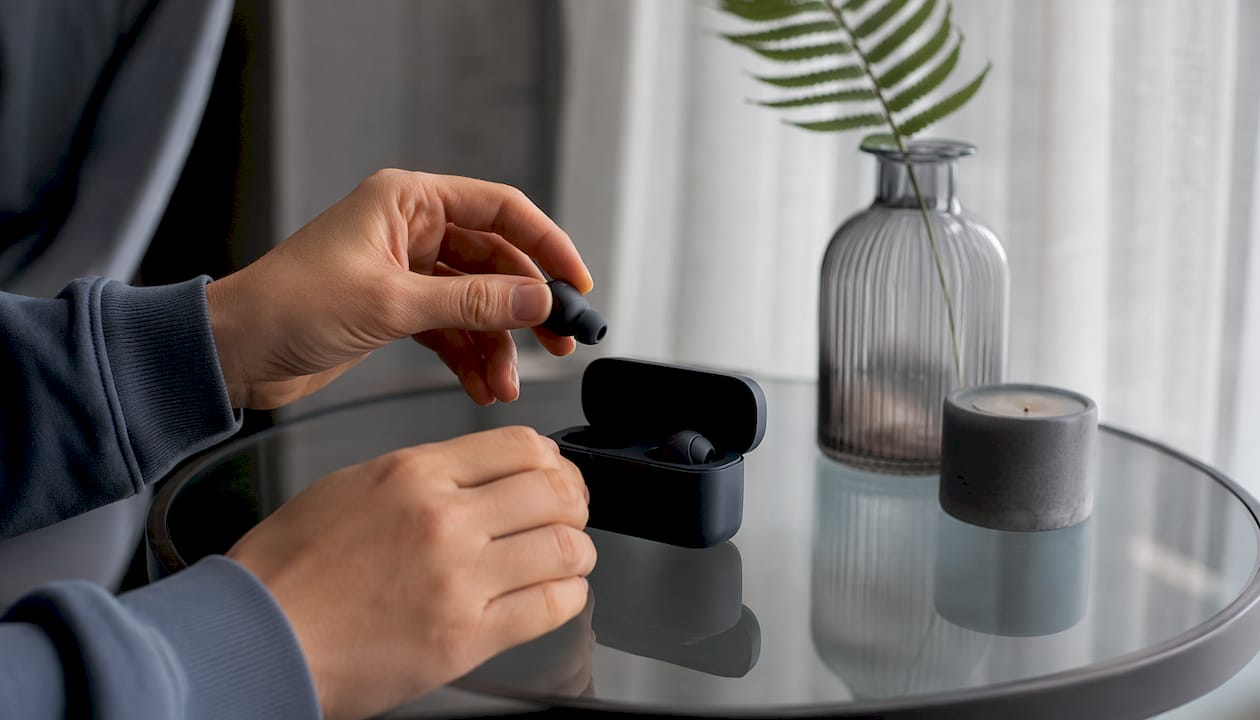
Active noise cancellation targets low-frequency engine drone, the constant rumble that sits beneath everything else on a long-haul flight. ANC works by generating an inverse sound wave that cancels the incoming noise before it reaches your ear canal. It is highly effective against steady, predictable sounds like turbine hum.
Passive isolation handles the higher-frequency noises: a passenger’s sharp laugh, a trolley rattling past, a child crying two rows back. Physical ear tips create a seal that physically blocks these sounds. The quality of that seal depends entirely on tip fit, which is why multiple tip sizes matter.
Sound masking audio fills in the gaps. Even with ANC and passive isolation working together, intermittent sharp sounds can still break through. A consistent layer of white noise, rain, or ocean waves smooths those spikes into tolerable background texture. Premium models achieve up to 42 dB of total noise reduction when all three layers operate together. That figure represents the difference between a loud restaurant and a quiet library.
Some advanced earbuds now include adaptive ANC that senses seal shifts during sleep and adjusts automatically. When you shift position and the ear tip moves slightly, the system recalibrates rather than letting noise flood back in. That consistency matters more on a ten-hour flight than raw peak performance.
Key noise sources earbuds address in travel environments:
- Engine drone (60–80 Hz low-frequency): best handled by ANC
- Cabin announcements and voices (500–3,000 Hz): passive isolation plus masking audio
- Sudden sharp sounds (above 3,000 Hz): passive isolation is the primary defence
- Pressure-related discomfort: vented designs reduce this, though they slightly reduce isolation
The challenge travel earbuds face that home use does not is the combination of all these noise types simultaneously, in a semi-reclined posture, with no ability to recharge mid-journey.
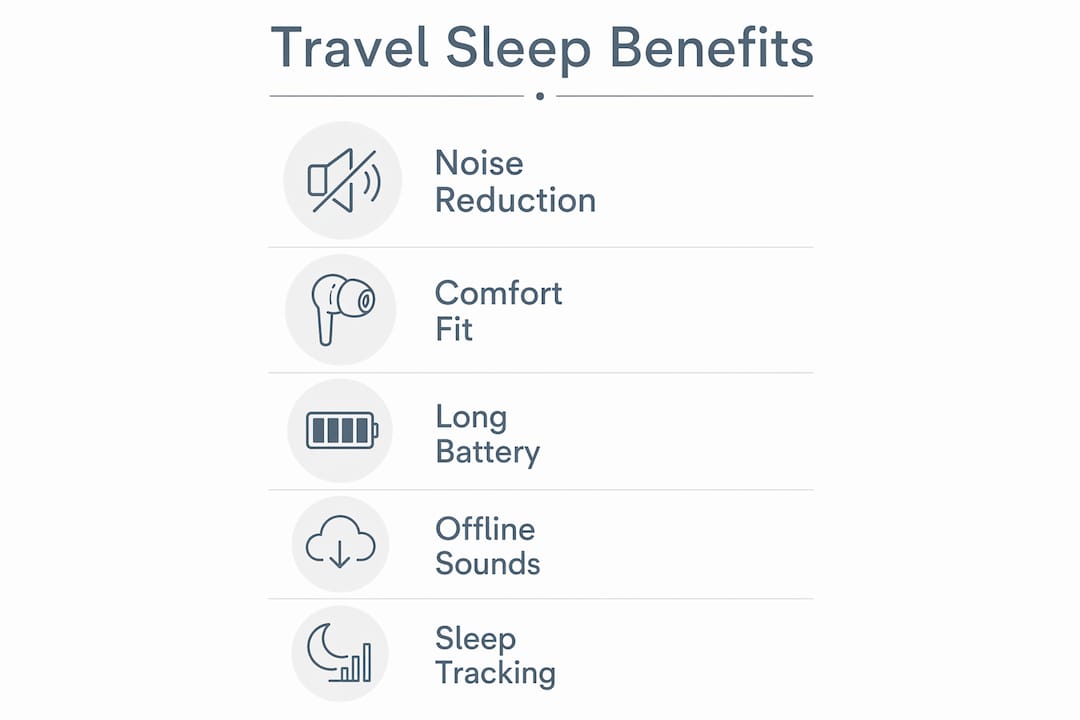
What features make Bluetooth sleep earbuds suited for travel comfort?
Design for travel sleep is a different brief from design for music listening. The priorities shift entirely toward wearability, endurance, and reliability in constrained conditions.
Slim profiles and ear tip options
Side sleepers pressing their head against a seat or travel pillow need earbuds with a low profile. A protruding driver housing creates pressure pain within an hour. Side sleepers may need ultra-slim earbuds designed specifically for sleep, not repurposed audio earbuds. Vented earbuds, thin profiles, and multiple tip materials (silicone, foam, and memory foam) help distribute pressure and maintain a seal across different ear shapes.
Battery life for long-haul flights
Battery life of 8–14 hours is the practical minimum for a long-haul flight. A London to Singapore route runs roughly 13 hours. Earbuds that die at hour nine leave you with nothing for the most valuable sleep window. Models with 10+ hours of continuous use and a charging case that fits in a jacket pocket are the practical standard for serious travellers.
Offline soundscape capabilities
Many airlines still restrict Bluetooth use during take-off and landing. Offline functionality with preloaded soundscapes, including ocean waves, rain, and wind, means you are not dependent on a phone connection or in-flight Wi-Fi. This also conserves your phone’s battery for the rest of the journey.
Pro Tip: Before boarding, download your preferred soundscapes to the earbuds directly rather than relying on a companion app. Some earbuds store up to eight hours of audio onboard, which removes any dependency on your phone entirely.
Additional features worth prioritising for travel:
- Water resistance (sweat and humidity in cabins are real)
- Carrying case that doubles as a charger
- Physical volume controls that work without unlocking a phone
- Auto-off timers that stop audio once you fall asleep
Entry-level Bluetooth sleep earbuds start around £18–£35, while ANC-enabled models sit between £100 and £150. The price gap reflects battery capacity, ANC quality, and tip variety. For frequent flyers, the premium tier pays for itself quickly. Check the carry-on sleep accessories checklist from Somnastudioshop for a fuller picture of what belongs in your travel kit.
How do sleep earbuds use audio and tracking to deepen relaxation?
The audio side of sleep earbuds is where the technology moves beyond noise management into active sleep support. Approximately 46% of adults use audio content to relax before sleep. Travel earbuds are built around that behaviour.
Preloaded soundscapes serve a specific function: they give your auditory system something predictable to process. A consistent sound like rain or brown noise occupies the part of your brain that would otherwise fixate on the cabin announcement you half-heard or the snoring passenger beside you. The result is faster sleep onset, not deeper sleep architecture, but getting to sleep faster on a flight is the primary goal.
Companion apps extend this with custom audio mixing, sleep tracking via movement sensors, and scheduled auto-off timers. The auto-off feature is underrated. Audio playing at low volume all night is not harmful, but it does drain battery. A timer set for 45 minutes after your target sleep time handles both concerns without requiring you to stay awake to switch anything off.
Pro Tip: Set your masking audio to a volume where you can just barely hear it over the ambient cabin noise. Louder is not better. The goal is to soften sharp sounds, not to replace them with a different loud sound.
Practical use cases where audio integration makes the biggest difference:
- Calming a snoring travel companion without confrontation
- Masking unpredictable cabin announcements on overnight flights
- Settling into sleep in an unfamiliar environment (hotel rooms, trains, buses)
- Reducing anxiety during turbulence by maintaining a consistent audio anchor
The primary value of Bluetooth sleep earbuds is creating a controlled sensory layer that softens sharp disturbances into tolerable background noise, not eliminating all sound. That distinction matters. Total silence is not the goal and is not achievable in a cabin. Managed, predictable sound is. For more on how audio technology pairs with sleep hygiene, Somnastudioshop’s guide on portable sleep hygiene kits covers the broader toolkit.
Are Bluetooth earbuds safe for sleep during travel?
Bluetooth sleep earbuds are generally safe for overnight use when volume stays low and hygiene is maintained. The two conditions are equally important.
- Keep volume below 60 dB. At that level, extended exposure carries no meaningful hearing risk. Most sleep-focused earbuds include app-based volume caps specifically for overnight use. Automatic turn-off features and volume controls within companion apps assist with this.
- Clean ear tips after every trip. Health experts advise regular cleaning to prevent irritation and infection. Prolonged in-ear sealing promotes cerumen (earwax) buildup, which can cause blockages over time. Silicone tips wipe clean easily; foam tips should be replaced every few weeks with heavy use.
- Remove earbuds during descent. Cabin pressure changes most sharply during descent. If you experience discomfort, removing the earbuds briefly allows pressure to equalise naturally. Vented earbud designs reduce this issue but do not eliminate it entirely.
- Stay aware of emergency audibility. ANC and passive isolation together can make cabin announcements inaudible. Leaving one earbud out or reducing ANC during boarding and meal service is a practical habit that keeps you connected to your environment.
- Earbuds are one tool, not a complete solution. Travellers with chronic sleep difficulties benefit most when earbuds are part of a broader approach that includes sleep tech for professionals, neck support, light blocking, and consistent pre-sleep routines.
The safety profile is strong. The risks are manageable with basic habits. The main limitation is that earbuds address sensory disruption but not the physiological challenges of sleeping upright, crossing time zones, or managing pre-travel anxiety.
Key takeaways
Bluetooth sleep earbuds reduce travel noise most effectively when ANC, passive isolation, and sound masking audio work together as a combined system rather than relying on any single layer.
| Point | Details |
|---|---|
| Triple-layer noise reduction | ANC, passive isolation, and masking audio together achieve up to 42 dB of noise reduction. |
| Battery life is non-negotiable | Choose earbuds with 8–14 hours of continuous use to cover full long-haul flights. |
| Offline audio is critical | Preloaded soundscapes remove dependency on Bluetooth connectivity during flight restrictions. |
| Hygiene and volume control | Clean tips after every trip and keep volume below 60 dB for safe extended use. |
| Earbuds work best in combination | Pair with neck support, light blocking, and sleep hygiene habits for reliable travel rest. |
What I have learnt from years of flying with sleep earbuds
My first long-haul flight with sleep earbuds was a revelation, and then a lesson in what I had got wrong. I had bought a pair of well-reviewed audio earbuds, not sleep earbuds, and by hour four my right ear was aching from the pressure of the housing against the seat headrest. The distinction between earbuds designed for listening and earbuds designed for sleeping in a seat is not marketing. It is a physical reality.
The seat position changes everything. Window seats let you lean against the fuselage, which means side-sleeping pressure is constant. Aisle seats mean you are more likely to sleep upright, which reduces pressure pain but increases exposure to trolley noise and passing passengers. I now carry two tip sizes and swap them mid-flight when one ear starts to feel uncomfortable. That small habit has extended my usable sleep window by at least two hours on overnight routes.
On battery management: I charge earbuds in the case during the taxi and take-off phase when Bluetooth is restricted anyway. By the time I can use them, they are at full charge. That habit alone has never left me with dead earbuds mid-flight.
The combination I have found most reliable is slim sleep earbuds with ANC for the engine drone, a preloaded rain soundscape running at low volume, and a travel neck pillow that keeps my head from dropping. No single item does the job. The system does. Travellers who try one tool and give up are usually missing one of the three components.
— Hadi
The Somnastudioshop approach to travel sleep audio
Earbuds handle the in-ear side of travel noise. The SomnaAura Pro Contour White Noise Sound Mask from Somnastudioshop adds an external layer of sound masking that works alongside Bluetooth earbuds rather than replacing them. The SomnaAura Pro is lightweight, portable, and designed for the specific acoustic conditions of travel, producing white noise that softens the ambient environment before sound even reaches your earbuds. For travellers who want a layered approach to blocking cabin noise, it fits naturally into a carry-on sleep kit. Somnastudioshop builds each product around the reality of disrupted sleep in modern travel, not idealised bedroom conditions.
FAQ
What is the best way to use Bluetooth earbuds for sleeping on a plane?
Use ANC earbuds with a preloaded masking soundscape, keep volume low, and set an auto-off timer for 45 minutes after your target sleep time. Slim, low-profile earbuds reduce pressure pain for side sleepers.
How many hours of battery life do travel sleep earbuds need?
A minimum of 8–14 hours covers most long-haul flights without mid-journey charging. Models with 10+ hours and a portable charging case are the practical standard for overnight routes.
Are Bluetooth earbuds safe to wear all night on a flight?
Bluetooth sleep earbuds are safe for overnight use when volume stays below 60 dB and ear tips are cleaned regularly. Automatic volume caps in companion apps make this easier to maintain without active monitoring.
Do sleep earbuds work without a phone connection?
Many sleep earbuds include offline soundscape libraries stored directly on the device, removing the need for a Bluetooth connection. This is critical during flight phases when wireless use is restricted.
What is the difference between sleep earbuds and regular earbuds for travel?
Sleep earbuds use ultra-slim housings, softer tip materials, and lower-profile designs to reduce pressure pain during extended wear in a seat. Regular audio earbuds prioritise sound quality over comfort during sleep positions.