
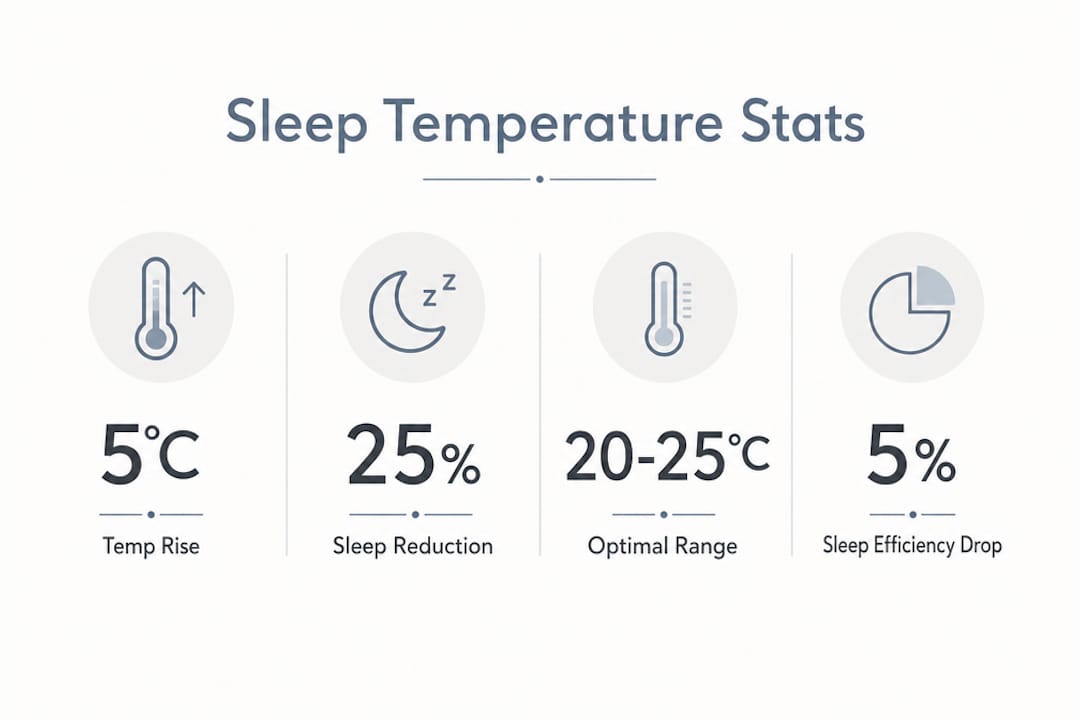
Temperature is the single most powerful environmental cue your body uses to decide when to sleep and how deeply to sleep. Research published in peer-reviewed journals confirms that sleep efficiency peaks when bedroom temperature sits within the biologically optimal range for sleep, and drops by 5–10% once the room climbs to 30°C. That is not a marginal effect. A 5–10% fall in sleep efficiency is comparable, in measurable impact, to the effect of evening alcohol consumption.
Here is what the evidence shows at a glance:
- Optimal range: 20°C–25°C ambient bedroom temperature maximises sleep efficiency and restfulness.
- Heat penalty: A 5°C rise in indoor nighttime temperature reduces total sleep time by approximately 23 minutes and delays sleep onset by 11–13 minutes.
- Sleep architecture: Elevated heat primarily strips away light sleep; cold nights extend both light and deep sleep.
- Mechanism: The hypothalamus drives core body cooling via vasodilation, and this cooling signal is what triggers sleep onset.
- Climate risk: Rising nighttime temperatures from climate change are making the problem worse, with older adults and lower-income households most exposed.
Why temperature affects sleep quality: the physiological mechanism
Your body does not simply “decide” to sleep. The hypothalamus orchestrates a precise cooling sequence that acts as the biological green light for sleep onset. As bedtime approaches, blood vessels in the hands and feet dilate, shedding heat from the core and producing a measurable drop in core body temperature. That drop is the signal. Without it, the brain stays alert.
The transition into non-REM (NREM) sleep coincides with further brain and body cooling, while shifts back to REM sleep or wakefulness are accompanied by brain rewarming. In practical terms, temperature is not just a comfort factor. It directly regulates which sleep stage you are in at any given moment.
- NREM sleep: brain and core temperature fall, enabling deep, restorative rest.
- REM sleep: brain temperature rises slightly; the body is closer to its waking thermal state.
- Wakefulness: core temperature is at its daily high, actively suppressing sleep drive.
Pro Tip: Warming your hands and feet about an hour before bed accelerates distal vasodilation, helping your core shed heat faster and shortening the time it takes to fall asleep.
Circadian temperature decline and NREM initiation are governed by the same hypothalamic circuits, meaning that thermoregulation and sleep are not parallel processes — they are the same process.
What happens to your sleep when the bedroom gets too hot
The numbers are specific enough to take seriously. A 5°C rise in indoor nighttime temperature cuts total sleep time by roughly 23 minutes and pushes sleep onset back by 11–13 minutes. During sustained heatwaves, that sleep loss grows to up to 24.7 minutes per night.
Heat disrupts sleep architecture in a particular way. During hot seasons, elevated night temperatures reduce light sleep duration significantly, while leaving deep sleep comparatively intact. Light sleep is not trivial. It supports mood regulation, cognitive processing, and the structural continuity of the sleep cycle.
| Temperature range | Effect on sleep |
|---|---|
| 20°C–25°C | Peak sleep efficiency and restfulness |
| 25°C–30°C | 5–10% drop in sleep efficiency |
| Above 30°C | Sleep onset delayed; total sleep time falls sharply |
| Heatwave nights (sustained) | Up to 24.7 minutes of sleep lost per night |
A 5–10% drop in sleep efficiency is large enough to impair next-day cognitive performance, mood, and postprandial glucose response — effects comparable to chronic pain or evening nicotine use.
How rising nighttime temperatures are making this worse
Climate change is not a future problem for sleep. It is already measurable. A large-scale study using data from 765,000 US survey respondents found that small increases in nighttime temperatures lead to measurable increases in nights of insufficient sleep across populations, amounting to a substantial public health concern.
The burden falls unevenly. Older adults and lower-income households face the sharpest effects, partly because they have less capacity to adapt their thermal environment through cooling systems. Urban heat island effects compound the problem in cities, where nighttime temperatures stay higher than surrounding areas.
Key challenges the warming climate creates for sleep:
- Increased frequency of hot nights that push bedroom temperatures above the 25°C threshold.
- Disproportionate impact on elderly people, whose thermoregulatory capacity declines with age.
- Limited evidence of fast biological adaptation to heat, meaning the body cannot simply “get used to it” quickly enough.
- Socioeconomic barriers to air conditioning and ventilation in lower-income housing.
- Chronic sleep loss compounding risks for cardiovascular disease, metabolic disorders, and poor mental health.
The scientific consensus, as summarised in a 2024 systematic review, is that environmental temperature control must be prioritised over any expectation of biological adaptation.
Practical ways to optimise your bedroom temperature for better sleep
Getting the thermal environment right is more nuanced than setting a thermostat. Research shows that bedroom temperature often differs from the household thermostat reading, particularly in top-floor rooms or older properties. A dedicated room sensor gives you accurate data to act on.
Practical steps that work:
- Target 20°C–25°C in the bedroom specifically, not just the hallway thermostat.
- Use breathable bedding made from natural fibres such as cotton or linen, which wick moisture and support temperature regulation during sleep.
- Ventilate strategically: open windows in the evening to flush out accumulated heat, then close them before outdoor temperatures rise again in the morning.
- Warm your extremities before bed using bed socks or a warm foot bath, triggering the vasodilation that accelerates core cooling.
- Use a fan or cooling device to create airflow, which helps the body shed heat even when ambient temperature is slightly above the ideal range.
- Monitor your specific room with a standalone thermometer or smart sensor rather than relying on a central thermostat.
Pro Tip: Sleep quality responds better to a dynamic microclimate that cools gradually through the night than to a fixed ambient temperature. If you use air conditioning, set it to drop slightly after midnight to mirror the body’s natural circadian cooling curve.
Smart thermostat technology, such as the Google Nest Learning Thermostat, can automate this kind of gradual overnight cooling schedule without manual adjustment.
How your body temperature shifts across the sleep cycle
Core body temperature is not static during sleep. It follows a predictable arc across the night, and understanding it explains why room temperature matters at different points, not just at bedtime.
Core temperature begins falling roughly two hours before sleep onset, reaching its lowest point about two hours after you fall asleep. Each transition into NREM sleep brings a small but measurable drop in brain temperature, around 0.2–0.4°C per episode. Transitions back to REM or wakefulness reverse this, with the brain warming slightly. By early morning, core temperature begins rising again, which is part of what pulls you out of sleep naturally.
This arc means that a bedroom that feels comfortable at 11 PM may feel too warm at 3 AM, when your body is trying to maintain its lowest thermal set point. A room that cools slightly through the night aligns with this biology rather than working against it.
Can cold temperatures disrupt sleep too?
Cold does affect sleep, though differently from heat. Research on a Chinese population found that cold nights extend total sleep time, including both light and deep sleep phases, suggesting that moderate cold is not inherently harmful. However, temperatures that are too low trigger the body’s heat-conservation responses: vasoconstriction, shivering, and increased metabolic activity. These are arousal signals, not sleep signals.
An 8°C drop in nighttime ambient temperature below 22°C is associated with a 5% reduction in sleep efficiency. Extreme cold also suppresses the restorative functions of sleep at the cellular level, with evidence that very low brain temperatures slow the processes that make sleep biologically useful. The sweet spot remains the 20°C–25°C range, where neither heat stress nor cold-induced arousal interferes with the sleep cycle.
How humidity and bedding interact with bedroom temperature
Temperature alone does not determine thermal comfort during sleep. Humidity changes how effectively the body loses heat through sweating. High humidity reduces the rate of sweat evaporation, which means the body cannot cool itself efficiently even when the air temperature is within the optimal range. The result is increased wakefulness and disrupted sleep continuity.
Bedding acts as a microclimate layer between your body and the room. Heavy synthetic duvets trap heat and moisture, pushing the skin microclimate above the threshold where sleep is disrupted, even in a cool room. Natural fibre bedding, by contrast, allows moisture to pass through and supports the gradual heat loss the body needs across the night. For people who run warm, a lower tog-rated duvet combined with a slightly cooler room often outperforms a heavier duvet in a warmer room. Tracking sleep quality changes alongside bedding and temperature adjustments is one of the most direct ways to find your personal optimum.
How Somnastudioshop supports your thermal sleep environment

Somnastudioshop designs products around the physiological realities covered in this article. The Somna Lift EMS Thermal Neck Contour Device applies targeted thermal stimulation to the neck, supporting the muscular relaxation and localised warmth that primes the body for sleep onset. The SomnaAura Pro pairs a contoured white noise sound mask with light-blocking design, addressing the two environmental factors that most commonly compound temperature-related sleep disruption: noise and light. Each product is built for people who take their sleep environment seriously and want tools that work with their biology, not against it.
Key takeaways
Temperature is the primary environmental driver of sleep quality, and keeping your bedroom between 20°C and 25°C is the single most effective environmental adjustment you can make.
| Point | Details |
|---|---|
| Optimal temperature range | Sleep efficiency peaks at 20°C–25°C; efficiency drops 5–10% as temperature rises to 30°C. |
| Heat and sleep loss | A moderate increase in indoor nighttime temperature reduces total sleep time by a substantial amount. |
| Body temperature arc | Core temperature falls for two hours before sleep onset and reaches its lowest point two hours after falling asleep. |
| Cold nights extend sleep | Cold seasons correlate with longer total sleep time, including increases in both light and deep sleep. |
| Monitor your room directly | Bedroom temperature often differs from the household thermostat; a dedicated sensor gives accurate data. |